 Market
 · 5 min read
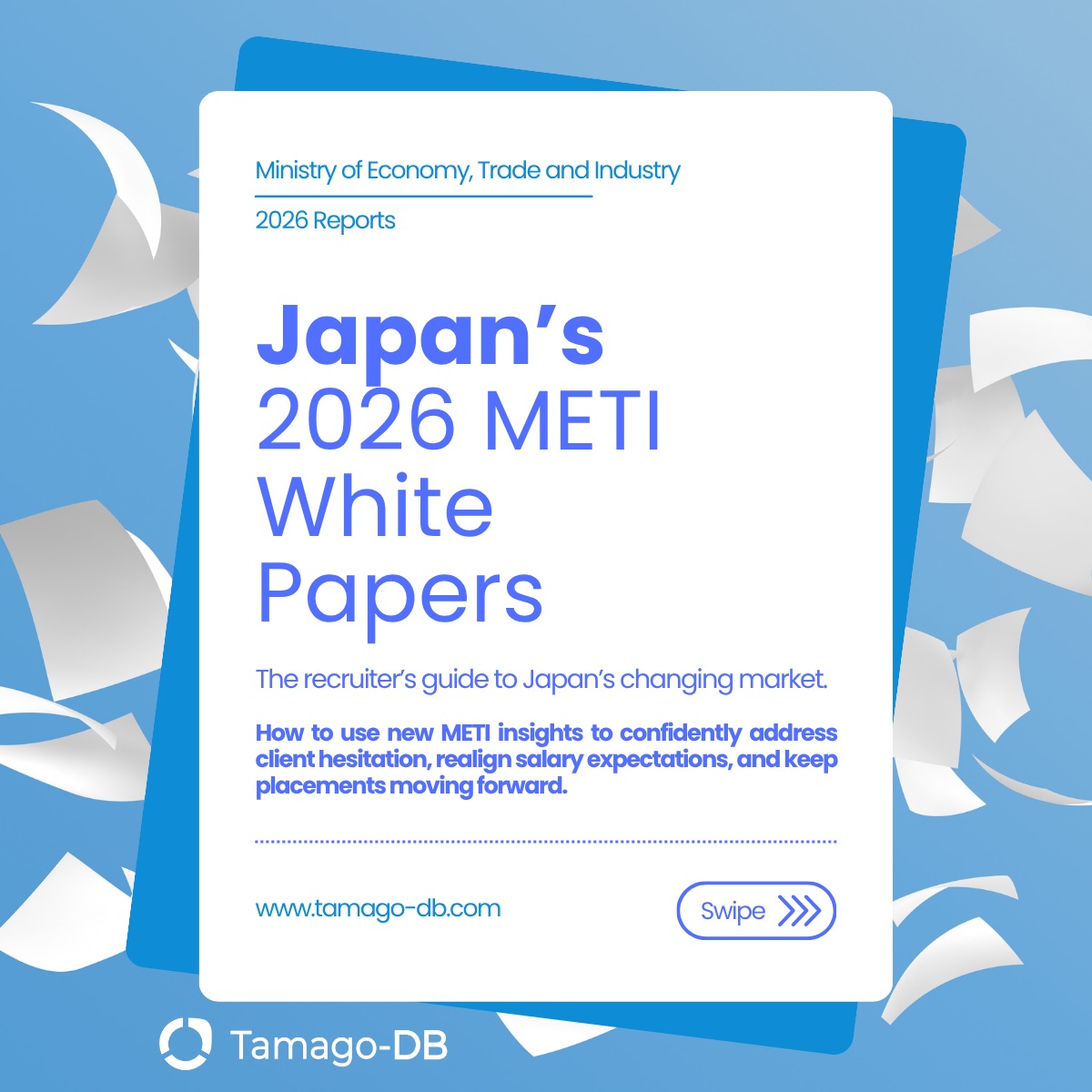
Navigating Japan’s New Economic Era: 2026 METI White Papers
The 2026 METI White Papers on Small and Medium Enterprises (SMEs) signal a massive tactical pivot for corporate Japan. For recruitment agency owners and consultants, this report on Japan’s structural labor shortage and SME transformation provides a blueprint for closing client placements.
When a client tells you, “We want to pause hiring until next quarter,” or “We can’t afford that salary range.” The data in these white papers gives you the exact leverage needed to overcome those objections.
Key Definitions
Before diving into the strategy, ground your client conversations in the official definitions used by the Japanese government:
- METI (Ministry of Economy, Trade, and Industry): The powerhouse ministry of the Japanese government responsible for drafting industrial policy, economic regulations, energy security, and foreign trade. They look at macroeconomic trends and dictate how Japan as a whole remains globally competitive.
- SMEA (Small and Medium Enterprise Agency): An agency operating directly under METI. SMEA focuses exclusively on the survival, digital transformation (DX), and economic viability of Japan’s smaller businesses. These businesses form the backbone of the domestic supply chain.
- White Papers (白書 – Hakusho): Official annual reports compiled by government ministries. They analyze the current state of an industry, and map out structural vulnerabilities (like labor shortages). These reports outline the policy directives the government will fund or enforce in the coming year.
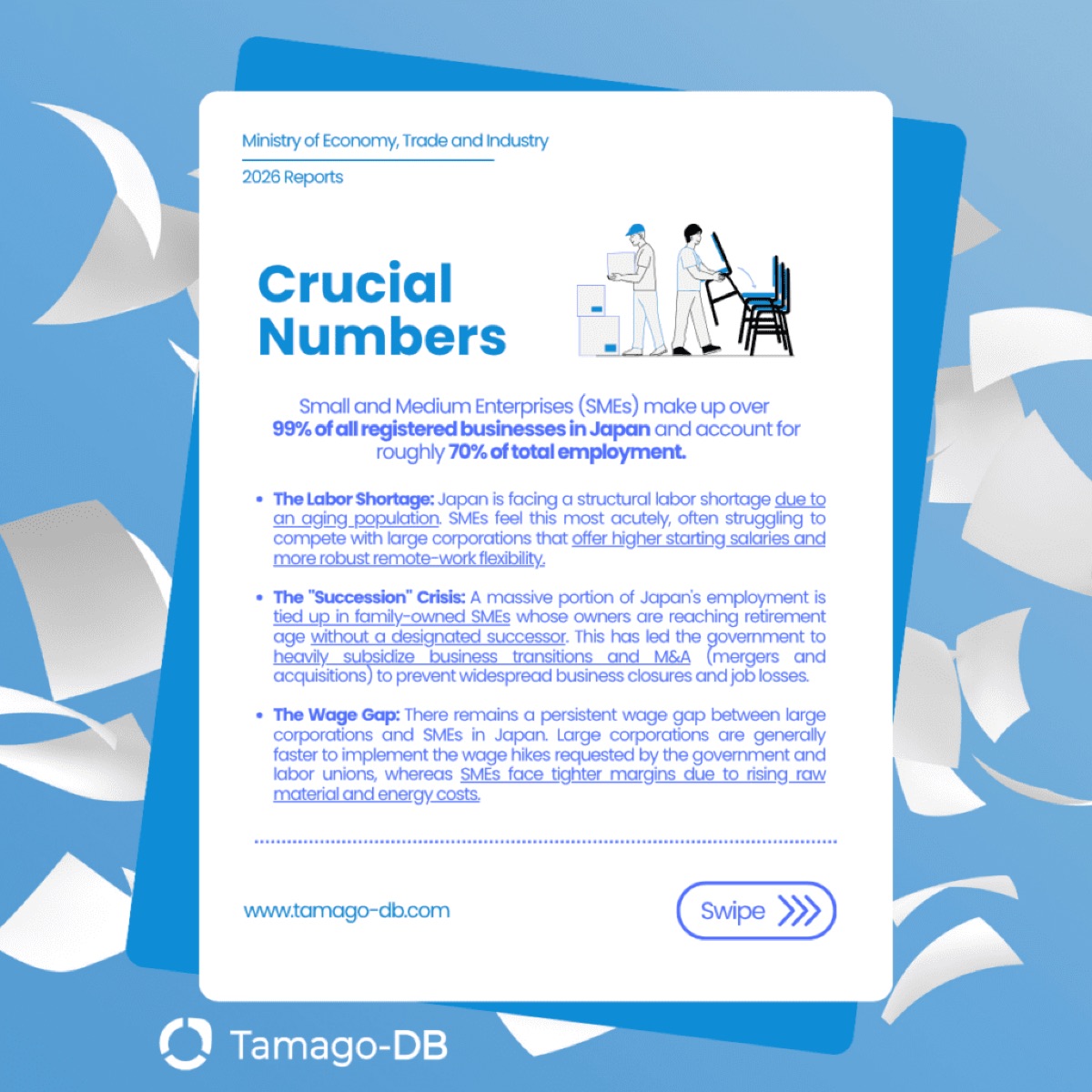
For the SMEs that employ 70% of Japan’s workforce, survival is no longer about doing more with less. It is about a fundamental shift toward high-added-value management and labor productivity. For recruitment consultants and agency owners, this insight shifts our role from “headhunters” to “structural transformation partners.”
Report Highlights
On April 24, 2026, the Japanese Cabinet officially approved the 2026 White Papers on Small and Medium Enterprises (SMEs).
With labor costs nearing an unsustainable 80% of revenue, smaller firms lack the financial flexibility to solve talent shortages through higher salaries alone.
Maintaining the status quo is now the greatest risk for Japan’s structural labor shortage and SME transformation. Facing severe economic shifts, businesses must pivot from short-term financial survival to long-term structural transformation, focusing aggressively on boosting their “earning power” (value-added creation) and elevating management literacy.
The Macroeconomic Squeeze: Why the Status Quo is Fatal
SMEs in Japan are currently caught in a multi-front economic vice. Understanding these constraints is essential to diagnosing your clients’ true pain points:
- The Debt & Import Vulnerability: Fiscal 2024 brought Japan’s first interest rate hikes in three decades. Because Japanese SMEs traditionally rely heavily on debt and are net-importers rather than exporters, rising rates combined with the weak yen are placing unprecedented downward pressure on gross margins.
- The “Deficit Wage Hike” Phenomenon: While the Shunto (spring labor negotiations) pushed wages to a 30-year high, the gap between large corporations and SMEs is widening. Crucially, the data reveals that SMEs are forcing wage increases purely to retain talent amid a structural shortage, even without improvements in business performance.
- The 80% Ceiling: With the labor distribution ratio (the percentage of company value spent on labor costs) hovering near 80%, SMEs have zero financial buffer left to simply “buy” their way out of the talent shortage through higher salaries.
The Industry Insight: Cost-cutting is dead. If an SME client refuses to hire because they are waiting for talent costs to drop, they are misreading the market. The structural labor shortage is permanent. The only viable path forward is increasing labor productivity through strategic capital investment, digitalization, and proper pricing strategies.
The Consultative Sales Matrix for Recruiters
When client companies express hesitation during the intake or offer stages, use these three pillars from the White Paper to reframe the conversation from “Hiring Cost” to “Value Creation”:
| Client Objection | The White Paper Insight | The Consultative Pivot |
| “We can’t afford to hire right now with rising interest rates and costs.” | Strategic Planning & Pricing: Companies that formulate robust business plans and execute effective cost pass-through strategies see higher wage growth and investment returns. | Reframe the candidate as a revenue generator, not an overhead cost. Introduce talent who can optimize pricing structures and differentiate product lines to absorb macro costs. |
| “We are losing people to bigger brands; we should focus on cost-cutting.” | Organizational & HR Management: Open management practices (sharing vision/metrics) and workplace environment improvements are the primary drivers of employee retention—not just baseline cash. | Consult the client on their Employer Value Proposition (EVP). Help them design “open management” communication styles and flexible working hours to attract talent that big corporations ignore. |
| “Our owner makes all the hiring decisions; we don’t need external managers.” | Personal Characteristics & Scaling: Founders who actively engage in reskilling and bring in external leadership talent show measurably higher business performance. | Gently challenge the “one-person” structure. Show the owner that hiring an operational second-in-command is the exact mechanism required to break through their current revenue ceiling. |
Moving Forward: The Legacy Approach
As cost-cutting reaches its absolute limits across Japan, driving internal labor productivity is the only way forward, for both your clients and your own recruitment firm.
Tamago-DB simplifies the complexities of the Japanese recruiting ecosystem. Whether you are a scaling boutique agency or an established executive search firm, Tamago-DB’s intuitive, recruitment-mapped architecture cuts down manual workflow hours, allowing your consultants to focus on closing deals and turning your data into your agency’s highest-yielding asset.
Position your agency on the right side of Japan’s economic inflection point.