
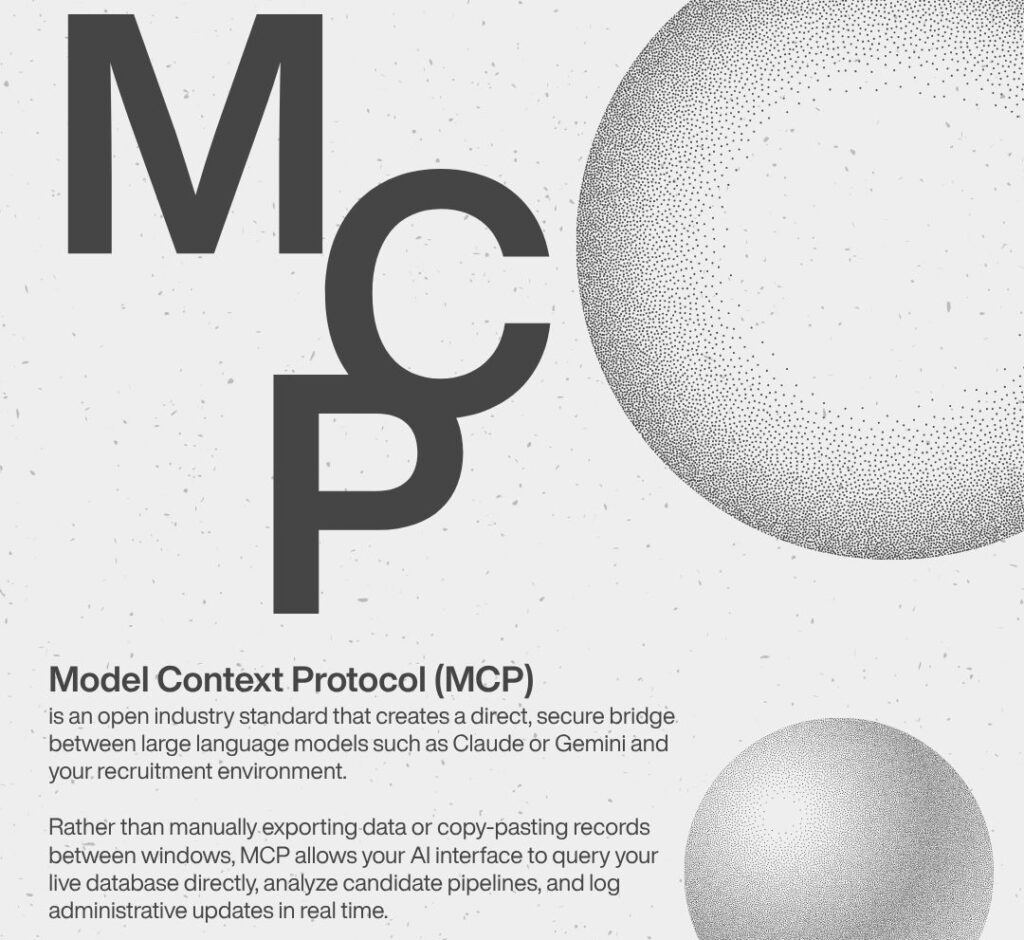
Model Context Protocol (MCP): Bringing AI into Your ATS
Model Context Protocol (MCP)
Model Context Protocol (MCP): Bringing AI into Your ATS Read More »
By March 2026, Japan’s food service sector had already reached 47,714 workers, hitting 95.4% of its FY2028 ceiling of 50,000. In response, the Immigration Services Agency of Japan (ISA) made history on April 13, 2026, by temporarily suspending new Certificate of Eligibility (COE) applications and skills evaluation tests for foreign restaurant workers. This development highlights
Japan is undergoing a monumental shift in its foreign labor policy. Following groundbreaking legislation enacted in June 2024, the Japanese government will officially replace its much-criticized Technical Intern Training Program (TITP) with the new Employment for Skill Development (ESD) Program (Ikusei Shūrō Seido / 育成就労制度) on April 1, 2027. This change represents a radical shift

As AI integration shifts from a competitive advantage to a baseline standard, the recruitment industry is facing a fundamental pivot. We have entered the era of the “Augmented Consultant.” While AI excels at data extraction—parsing resumes, scraping profiles, and transcribing interviews with perfect accuracy—it lacks the ability to calculate nuance. In this new landscape,
The New Currency of Recruitment: Moving From Data Extraction to Human Context Read More »

In modern recruitment, most firms find themselves locked in a “Red Ocean”—a market space defined by cutthroat competition and shrinking margins. In this environment, everyone is fishing in the same crowded waters, chasing the same active candidates on the same job boards, and wondering why the cost of acquisition rises every year. To break this
From Competition to Creation: Applying Blue Ocean Strategy to the Recruitment Lifecycle Read More »

In their landmark work, Blue Ocean Strategy, W. Chan Kim and Renée Mauborgne challenge the traditional logic of strategic competition. Most companies fight in “Red Oceans”—crowded markets where rivals compete on the same terms, leading to “bloody” competition, shrinking profit margins, and stagnant growth. The alternative? Creating a Blue Ocean: an uncontested market space that
In the modern recruitment landscape, the Applicant Tracking System (ATS) is often relegated to the role of a digital filing cabinet—a passive repository for resumes and contact details. However, when leveraged with intentionality, an ATS evolves from a basic administrative tool into a significant competitive advantage. The difference between a standard recruitment process and an
Unlocking the Strategic Potential of Your ATS: A Framework for Competitive Advantage Read More »

For too long, recruitment has been driven by hustle, KPIs, and transactional relationships. Yet Japan’s market is evolving—talent is scarce, clients demand consultative value, and technology is transforming how we work. Agencies relying on consultants armed with a phone list or basic database are falling behind. It’s time for managers to future-proof their business by
Building the Consultant of the Future: A Framework for Modern Recruitment in Japan Read More »

Influencing passive candidates is often considered the “holy grail” of recruitment in Japan. However, achieving this requires more than just persistence; it requires a fundamental shift in strategy. Japan’s labor market remains one of the most challenging in the world. Talent is scarce, and the professional psyche differs significantly from Western norms. In this market,
The Art of Influence: Navigating Japan’s Passive Candidate Market Read More »

In Japan’s fiercely competitive recruitment landscape, most agencies claim to “go the extra mile.” However, in a maturing market, clients are no longer looking for mere effort; they are seeking partners who solve complex business problems rather than those who simply fill seats. When a critical vacancy arises, the true value of a recruitment partner
Beyond the Permanent Hire: Leveraging Fractional Talent as a Strategic Solution Read More »