
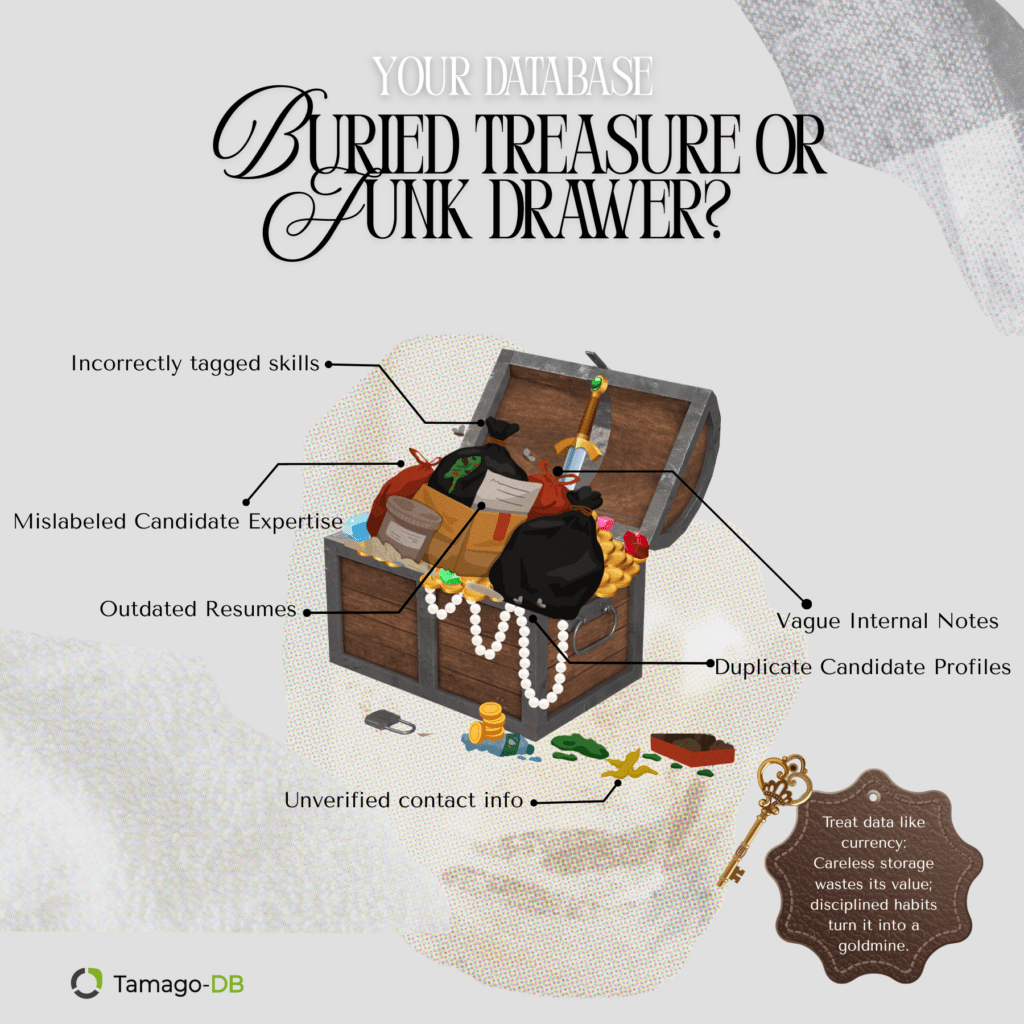
An Applicant Tracking System (ATS) is fundamentally a search and matching engine. However, its efficacy is directly proportional to the quality of its inputs. Without a rigorous approach to data management, a system quickly regresses into digital clutter—a repository of inconsistent records that obscure high-value candidates when they are needed most.
To transform an ATS into a strategic asset, agencies must move beyond treating it as a passive contact list and instead implement a framework of “Data Discipline.”
The Pillars of Structured Data
The transition from a disorganized database to a searchable “goldmine” requires a commitment to consistency. When information is stored in a structured, uniform manner, the ROI of the database begins to compound.
1. Define Non-Negotiable Data Points
Identify the core fields that drive your specific industry. For recruitment in Japan, this typically includes:
- Standardized Job Titles and Salary Expectations
- Hard Skills and Professional Certifications
- Language Proficiency levels (e.g., JLPT/TOEIC)
- Verified Contact Preferences
2. Prioritize Structure Over Free Text
While “Notes” and “Comments” boxes are useful for context, they are the enemies of searchability and reporting.
- The Strategy: Utilize dedicated, drop-down, or multi-select fields for critical data.
- The Impact: This ensures that your reporting is reliable and that your search filters capture every eligible candidate in the system.
3. Operational Velocity and Validation
Data has a half-life; the longer it remains outside the system, the less accurate it becomes.
- The 24-Hour Rule: Aim to enter new candidate and client profiles within 24 hours of contact to prevent memory gaps and record duplication.
- Verified Parsing: While AI-driven CV parsing significantly increases speed, it should never replace human validation. A quick manual review for accuracy ensures the integrity of the database remains intact.
The Taxonomy of Tagging: A Controlled Vocabulary
Tagging is the most powerful tool for granular searching, yet it is also the most prone to “bloat.” Inconsistent tagging creates silos where candidates are hidden behind slightly different labels.
- Standardize Your Labels: Establish a strict internal vocabulary. For example, decide on a single standard for bilingual talent (e.g., “JP/EN”) rather than allowing variations like “Bilingual” or “Japanese/English.”
- Eliminate Subjectivity: Avoid vague tags such as “Good Candidate” or “Pending.” Tags should be objective, focusing on industry, skill sets, and seniority levels.
- Regular Auditing: Periodically review your tag library. If tags are redundant, unique to only one record, or unnecessary, they should be merged or eliminated to maintain a high-functioning search environment.
Conclusion: Data as a Compounding Asset
In the modern recruitment market, data should be treated as a form of currency. Careless storage and poor discipline devalue your agency’s intellectual property. Conversely, disciplined habits ensure that your data remains a high-yield asset that provides a genuine competitive advantage.
The goal is simple: ensure that the best candidate for a role is never lost in a sea of unsearchable text.