
Work is no longer a destination or a role, it’s a continuous journey of reinvention.
The 2025 report arrived at a critical juncture, providing a data-driven look at the five-year window leading to 2030. Covering 22 industry clusters, it highlights a global economy attempting to balance rapid AI integration with the realities of a “Green Transition.” The sheer scale of the data confirms that we are no longer in a period of incremental change; we are in a period of structural churn affecting 22% of all current roles.
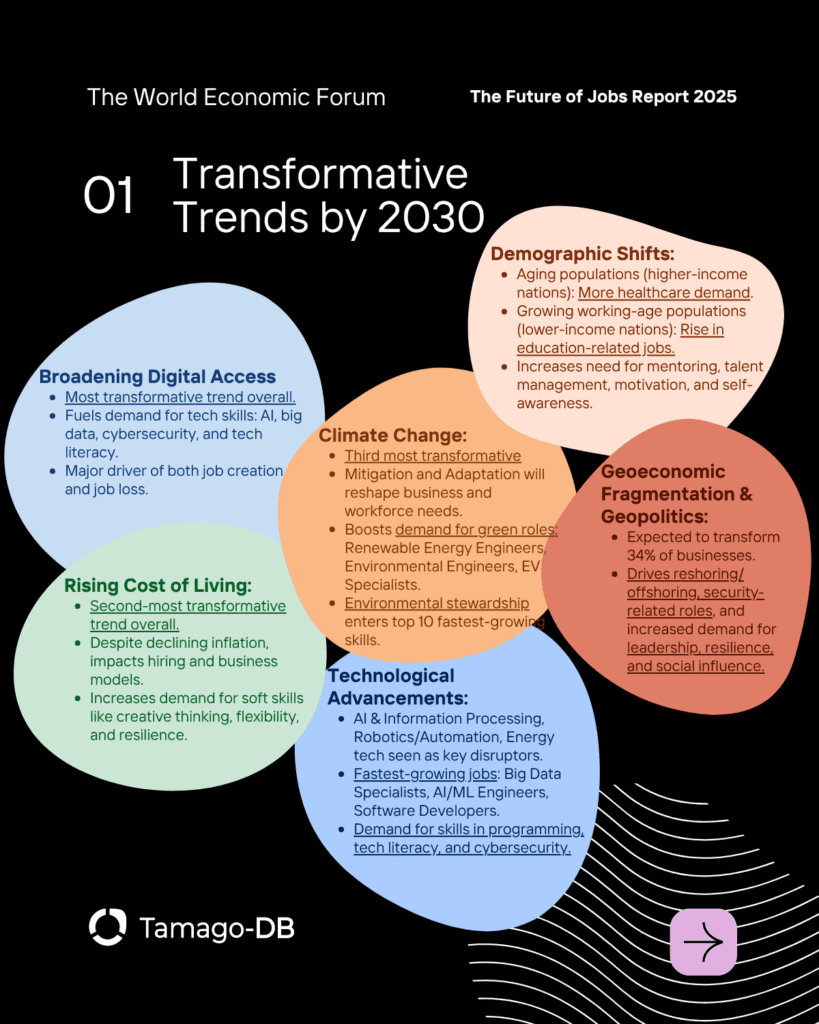
1. Transformative Trends by 2030
While AI captures the headlines, the report identifies Broadening Digital Access as the #1 transformative force, with 60% of employers citing it as a business-critical driver.
- The Big Three: AI and information processing (86%), climate-change mitigation (47%), and geoeconomic fragmentation (34%) are the primary engines of change.
- Demographic Duality: We are seeing a “split-screen” world. High-income economies are grappling with aging populations and shrinking workforces, while lower-income regions are seeing a surge in young, working-age populations—each requiring vastly different talent strategies.
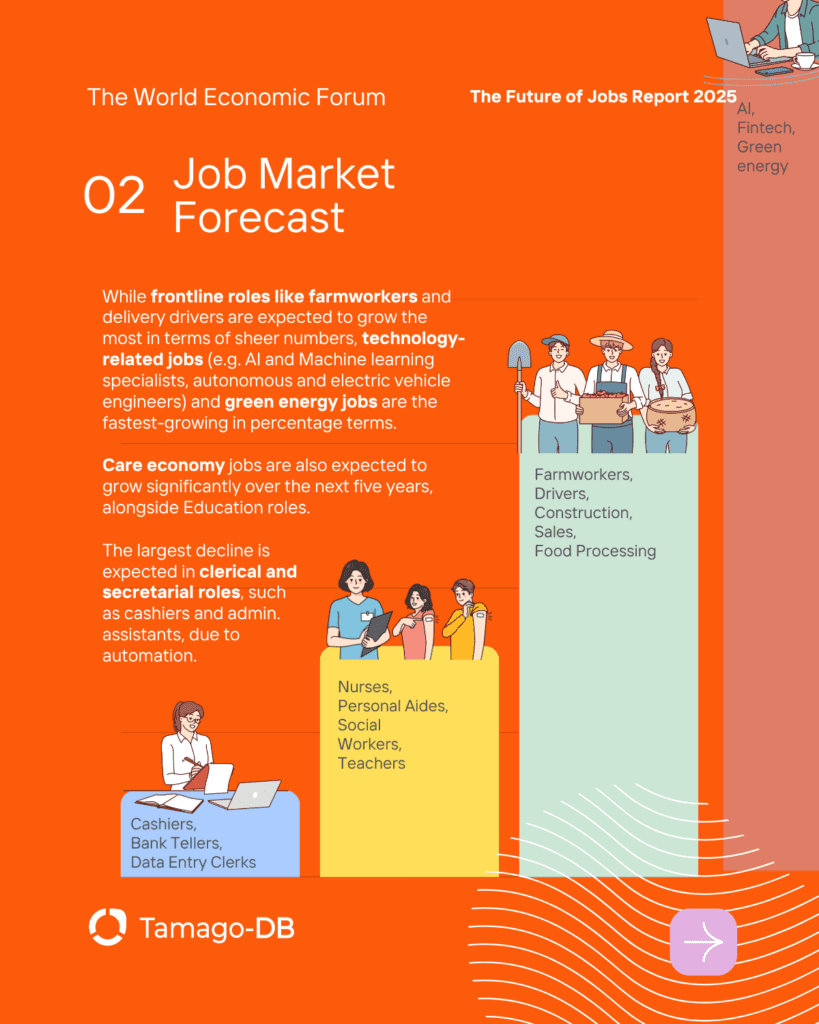
2. Job Market Forecast: The 78 Million Net Gain
Despite fears of “robocalypse,” the numbers tell a story of expansion. By 2030, the global economy is projected to create 170 million new jobs, while displacing 92 million, leaving a net gain of 78 million.
| Growth Sectors | Declining Sectors |
| Frontline & Logistics: Delivery drivers, construction, and food processing. | Routine Clerical: Bank tellers, postal clerks, and data entry. |
| Care & Education: Nursing, counseling, and secondary school teachers. | Admin & Secretarial: Cashiers, ticket clerks, and executive secretaries. |
| Tech & Green: AI specialists, sustainability experts, and fintech engineers. | New Disruption: GenAI is now affecting creative roles like Graphic Designers. |
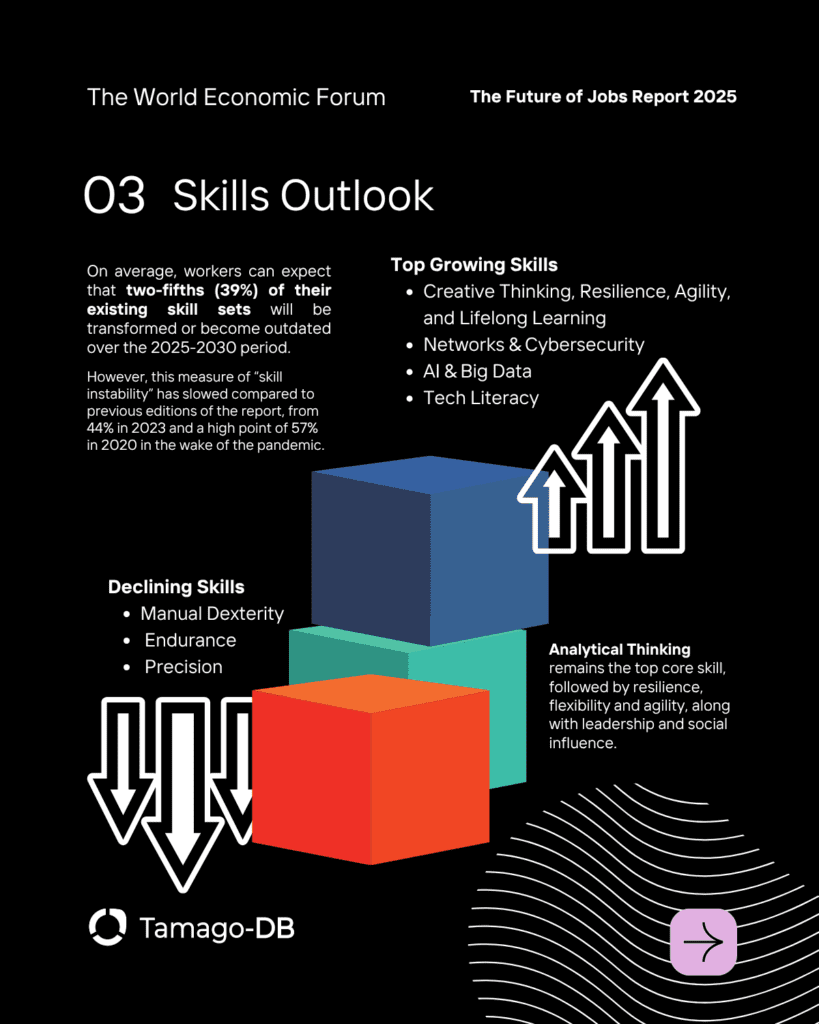
3. Skills Outlook: The 39% Churn
The report confirms a “Great Skills Reset.” Roughly 39% of core job skills will be outdated by 2030. While this is a slight stabilization from the 44% churn predicted in 2023, the complexity of required skills has skyrocketed.
- The Cognitive Anchor: Analytical Thinking remains the #1 most sought-after skill (essential for 7 out of 10 firms).
- The Tech Tier: AI, Big Data, and Cybersecurity are the fastest-growing technical domains.
- The Green Rise: For the first time, Environmental Stewardship has entered the top 10 list of fastest-growing skills.
- The Human Advantage: Creative thinking, resilience, and curiosity are being prioritized to complement machine capabilities.
4. Workforce Strategies & Training Needs
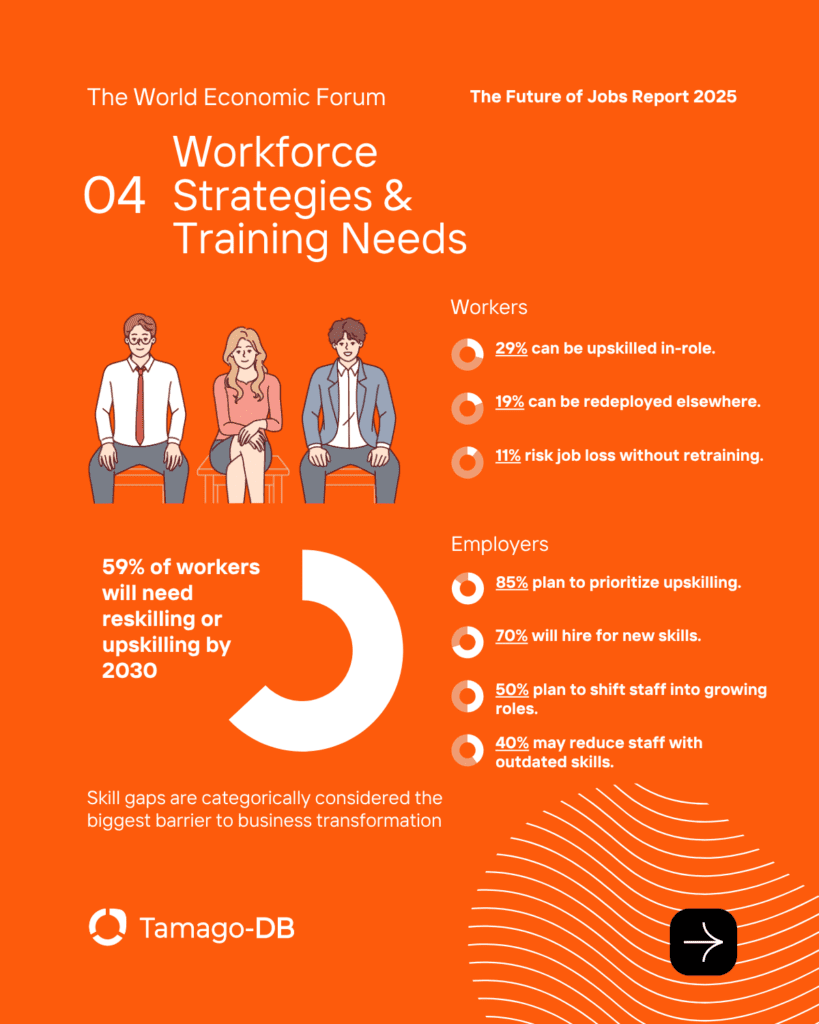
Skill gaps are now the #1 barrier to business transformation, cited by 63% of employers.
- The Training Mandate: 59% of the global workforce needs reskilling by 2030.
- Employer Action: 85% of firms are prioritizing internal upskilling, and 50% plan to transition staff from declining roles into growing divisions rather than laying them off.
- The Risk Factor: Approximately 11% of workers—representing 120 million people—are at high risk of redundancy because they lack access to the necessary training pipelines.
5. Talent, DEI, and Compensation Trends
To win the “War for Talent” in 2026 and beyond, the focus has shifted from mere recruitment to total employee value.
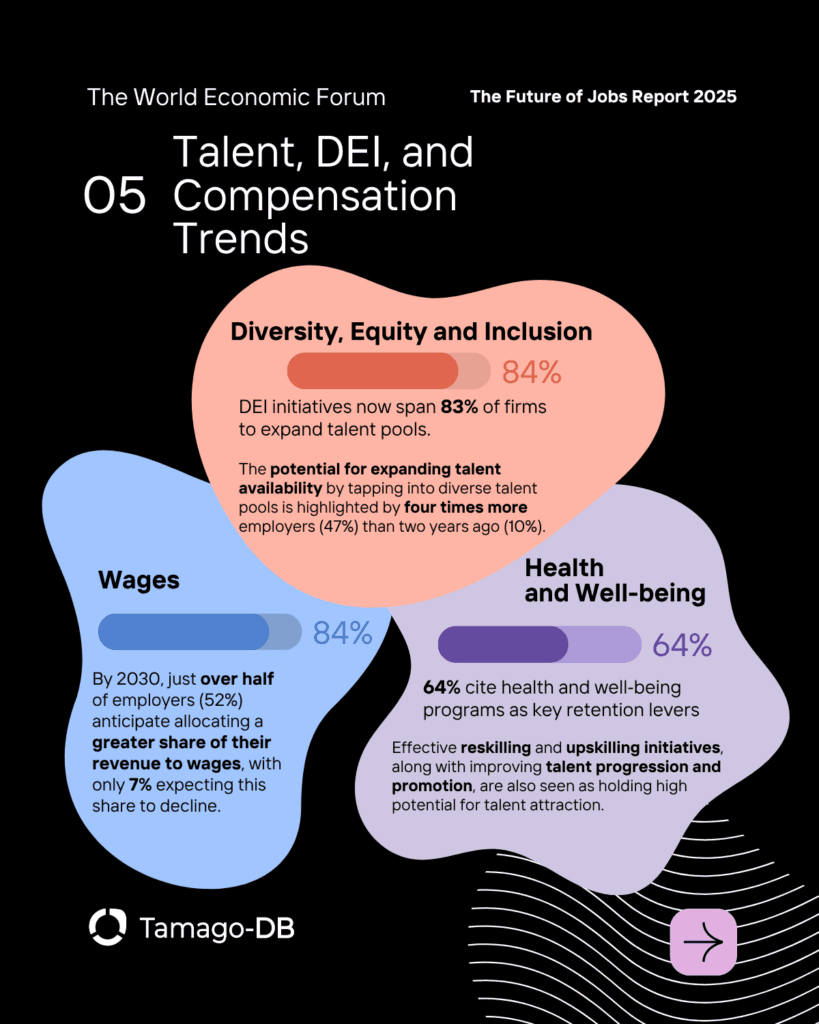
- Well-being as Strategy: 64% of employers now view worker health and well-being as their primary tool for talent attraction.
- DEI Maturity: 83% of firms have formal DEI initiatives. Interestingly, companies are now 4x more likely to use DEI to expand their talent pools compared to 2023.
- Compensation & AI: While employers plan to raise wages to stay competitive, they are also using AI to “augment” roles, allowing workers to move into high-value “agent orchestrator” positions where they manage portfolios of AI tools.
Navigating the “Great Reset”
The findings of the Future of Jobs Report 2025 underscore a pivotal shift from reactive hiring to proactive workforce architecture. As we look toward 2030, the primary challenge for organizations will not be the scarcity of roles, but the widening alignment gap between available talent and evolving skill requirements.
For recruitment agencies and HR tech providers, the “Great Reset” represents a move away from matching keywords to matching potential and adaptability. With nearly 40% of skills facing obsolescence, the most resilient organizations will be those that:
- Prioritize Skill-Based Hiring: Shifting focus from static credentials to dynamic competencies like analytical thinking and technological literacy.
- Leverage AI for Augmentation: Using automation not to replace staff, but to transition workers into high-value, tech-enabled roles.
- Embed DEI and Well-being: Treating inclusion and mental health as core business strategies to unlock larger, more diverse talent pools.
The next five years will reward the “agile employer”—those who view their workforce not as a fixed cost, but as a renewable asset that requires constant investment, upskilling, and strategic care. In this new era, the most valuable currency won’t just be what a candidate knows today, but how quickly they can learn for tomorrow.