
At the midpoint of 2026, Japan is shifting from decades of caution toward an aggressive, growth-oriented economic model. Backed by sweeping tax incentives and trillions of yen in partnerships, Prime Minister Sanae Takaichi’s cabinet is transforming the nation’s megadevelopments. Tokyo is intentionally moving away from traditional austerity under her signature framework of “responsible and proactive” public finance. Instead of short-term supplementary budgets, the government is now funding massive, multi-year strategic pipelines. By 2040, these public-private investments are projected to exceed 370 trillion yen.
For executive search firms, corporate strategists, and institutional investors, understanding the ground-level realities of these five megadevelopments are essential. Focus on these areas where leadership demand and talent scarcity will peak over the next decade.
1. Semiconductor Manufacturing: Rebuilding the Foundry of East Asia
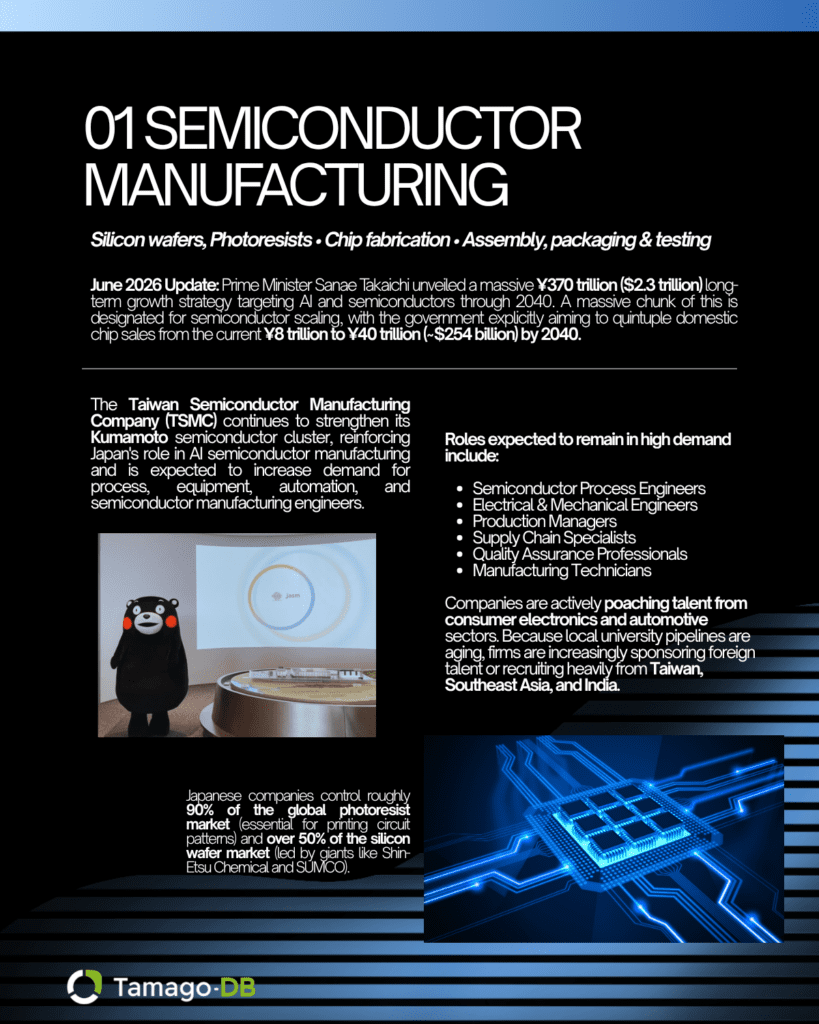
Japan’s semiconductor sector is undergoing a profound structural reindustrialization driven by national economic security priorities and state-directed capital allocation. Tokyo is executing a multi-trillion-yen strategy to reshore advanced fabrication capabilities and achieve digital sovereignty amid shifting global supply chain dynamics. This aggressive intervention has successfully repositioned the domestic market as a critical, high-growth node within the global technology ecosystem.
The national strategy is anchored by the state-backed foundry enterprise Rapidus in Chitose, Hokkaido. Rapidus recently completed an additional 150 billion yen government capital injection via the Information-Technology Promotion Agency (IPA), bringing its structural funding closer to targeted mass-production requirements. The facility is currently installing advanced processing machinery to pilot 2-nanometer logic chips by 2027, while concurrently establishing research frameworks with European institutes to secure long-term commercial pipelines.
Simultaneously, Taiwan Semiconductor Manufacturing Company’s (TSMC) rapid operational deployment in Kumamoto has revitalized Japan’s midstream industrial infrastructure. The first fabrication plant is fully operational, establishing a benchmark for accelerated regulatory approval and construction execution. Work continues on a second co-located facility engineered to produce specialized nodes for automotive applications and advanced image sensors.
This macroeconomic pivot has generated a profound demand supercycle for upstream Japanese equipment and materials manufacturers. Driven by global artificial intelligence infrastructure demands, domestic equipment sales are projected to expand by 12% to approximately 5.50 trillion yen for fiscal 2026. However, the speed of this capital deployment has exposed an acute regional deficit in specialized engineering talent, which remains the primary operational bottleneck to sustained capacity expansion.
2. AI Data Centers: Securing Digital Sovereignty
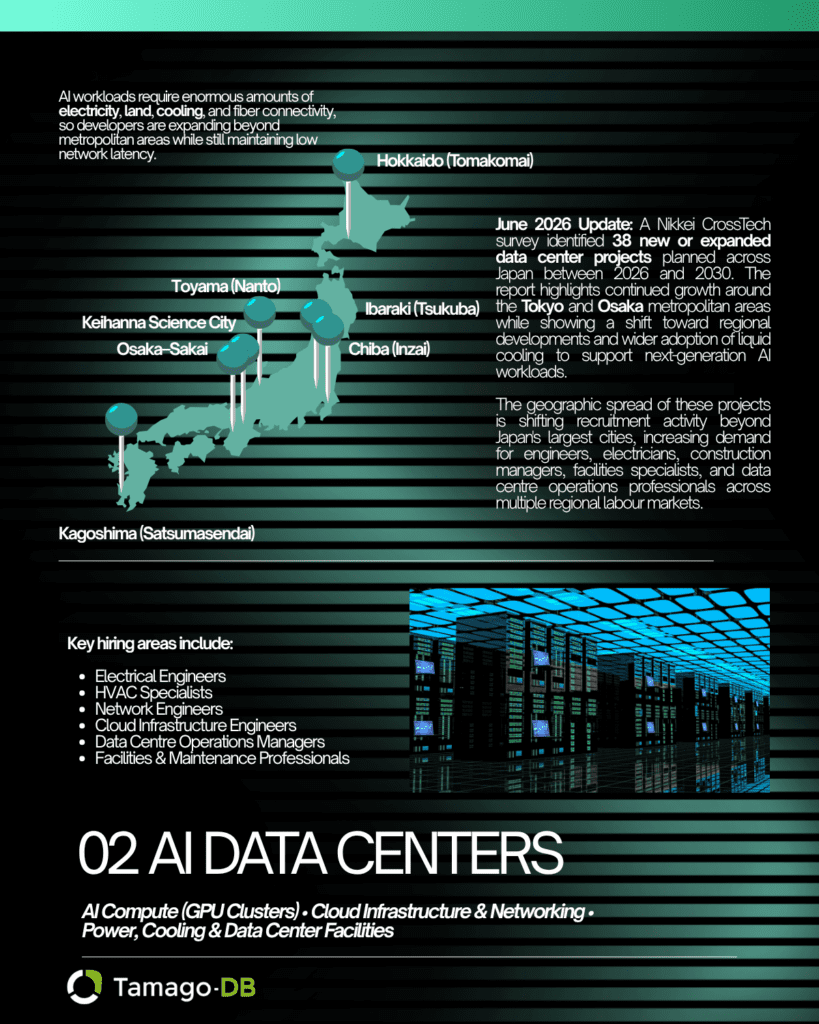
Japan’s artificial intelligence infrastructure market is entering an unprecedented phase of structural growth. Domestic spending on AI infrastructure is projected to surge close to 1 trillion yen (5.5 billion dollars) this year.
To support this massive expansion, global tech giants and local consortiums are heavily funding regional infrastructure. For example, KDDI Corporation partnered with Sharp Corporation to convert a manufacturing plant into a major GPU-powered facility. This custom AI data center in Osaka is targeting operational readiness by the end of the year.
At the same time, massive energy demands are forcing a shift toward specialized building designs. Modern facilities require far higher rack densities and advanced liquid cooling systems to support intensive GPU processing.
The government is actively clearing bureaucratic hurdles to keep pace with these architectural requirements. A regulatory reform panel recently called for easing strict building standards regarding high-capacity lithium-ion batteries. Prime Minister Sanae Takaichi emphasized that Japan will continuously modernize regulations to fit the fast-moving AI era.
3. The Chuo Shinkansen: A Superconducting Masterpiece of Engineering
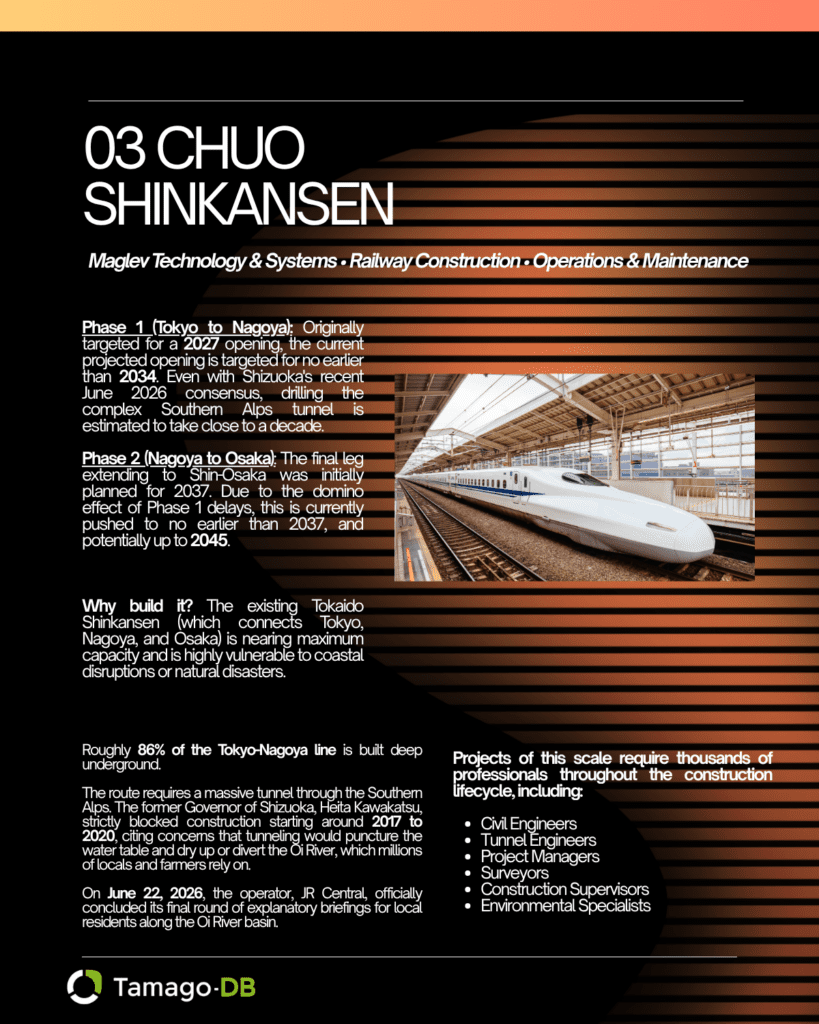
The Chuo Shinkansen Maglev is a highly ambitious transport project. It will connect Tokyo and Nagoya in just 40 minutes. Eventually, the line will reach Osaka in only 67 minutes. The revolutionary train operates at an incredible 500 kilometers per hour. This massive infrastructure serves as a critical national resilience asset. It provides essential transport redundancy to protect Japan’s economy. Specifically, it safeguards logistics if earthquakes damage the Tokaido Shinkansen.
Achieving these extreme speeds requires a uniquely difficult engineering feat. The maglev cannot tolerate sharp curves to maintain its velocity. It must travel straight through mountain ranges and deep bedrock. Consequently, roughly 86 percent of the 286-kilometer line is underground. The ultimate bottleneck is a 25-kilometer stretch beneath the Southern Alps. Engineers are digging under a rock overburden of 1,400 meters. This extreme depth equals the weight of four stacked Tokyo Towers.
Meanwhile, complex excavation is occurring deep beneath active city centers. Platforms are being built 40 meters under Shinagawa and Nagoya stations. Super general contractors must manage ground displacement down to the millimeter. This extreme precision ensures daily bullet train commutes overhead remain unaffected.
However, geological realities and rising material costs have severely escalated budgets. JR Central recently adjusted the construction budget for the Tokyo-Nagoya segment. The massive project is now estimated to exceed 11 trillion yen. Furthermore, environmental and political hurdles have caused significant timeline delays. The target opening date has been pushed back to at least 2035. Despite recent progress in Shizuoka, the commercial launch remains highly uncertain.
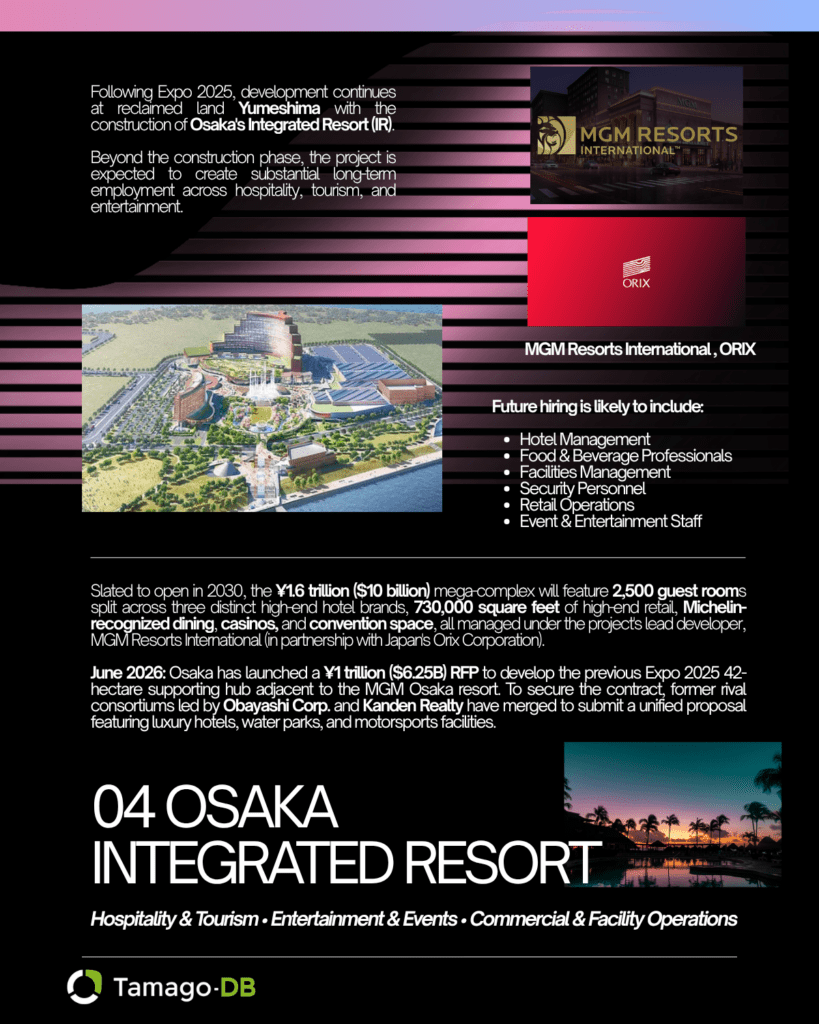
4. The Osaka Integrated Resort (IR): Post-Expo 2025
Following the conclusion of the World Expo 2025, Osaka’s tourism landscape pivoted instantly toward its next massive anchor. The city is preparing for Japan’s first approved casino-integrated resort on Yumeshima Island.
Spearheaded by MGM Resorts International and Orix Corporation, this US$10 billion project anchors the region’s newest megadevelopments. The complex features 2,500 luxury hotel rooms and a massive 68,000-square-meter MICE convention space. High-end retail and a highly regulated gaming floor are expected to generate 520 billion yen annually.
These scale-defining megadevelopments are fundamentally restructuring Osaka’s urban geography. Permanent rail and road expansions built for the Expo now serve as direct transit pipelines. The Osaka Metro Chuo Line extension connects the city center straight to the resort site.
Consequently, investor sentiment in the region has reached historic highs. Real estate funds that historically focused on Tokyo are aggressively diverting capital into Osaka commercial properties. These investors predict a sustained rise in land values, fueled by the creation of 93,000 regional jobs.
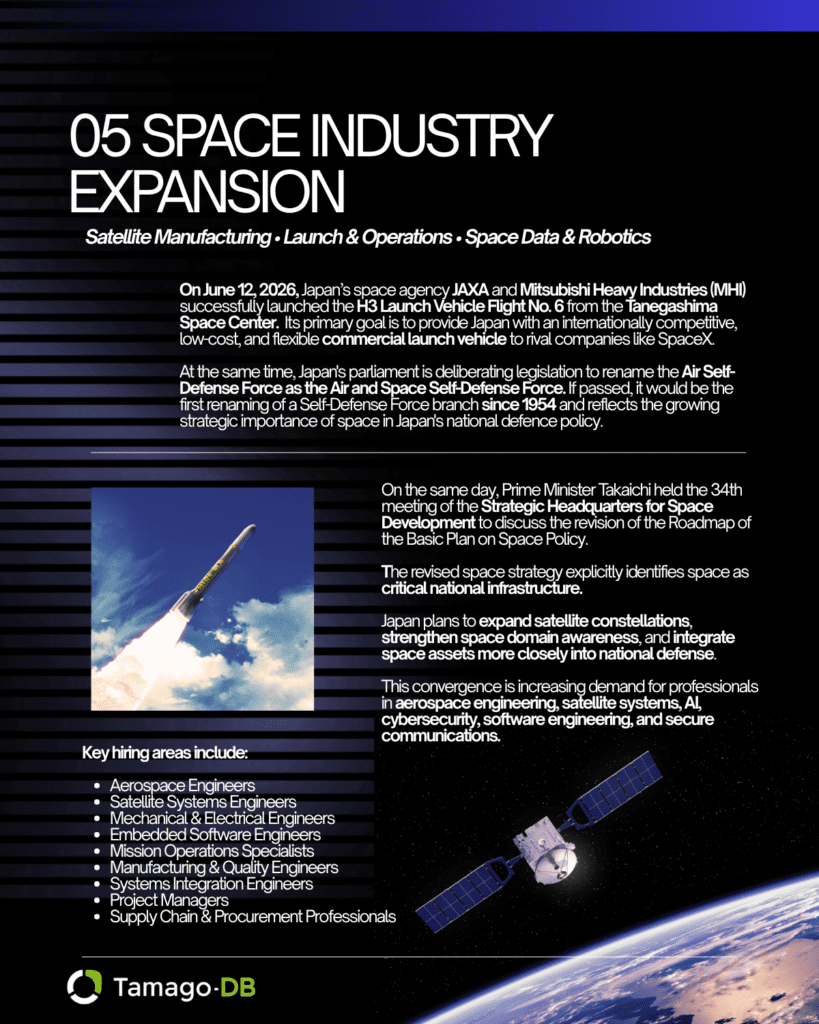
5. Space Industry Expansion: Reaching New Orbital Heights
Japan’s aerospace sector is undergoing a massive transformation to capture a larger share of the global commercial space market.
The national government is heavily backing this expansion with unprecedented long-term financial commitments. A dedicated space strategic fund worth one trillion yen was established to bolster private sector research and development. This massive capital injection aims to accelerate domestic innovation and secure supply chain autonomy over the next decade.
Crucially, the nation’s commercial launch capabilities recently achieved a monumental technical breakthrough. The flagship H3 rocket successfully debuted its highly anticipated, low-cost variant from the Tanegashima Space Center. This newly engineered configuration completely eliminates solid rocket boosters. Instead, it relies on three highly efficient, liquid-fuel main engines to drastically cut launch expenses.
This streamlined architecture allows the vehicle to offer highly competitive pricing on the international market. Furthermore, the successful flight safely deployed six distinct satellites into orbit. This critical success effectively restores global confidence in the program following previous development setbacks.
At the same time, private aerospace startups are scaling rapidly across the country. Companies are designing innovative launch vehicles and advanced satellite constellations to provide high-frequency imaging services. This thriving startup ecosystem is successfully transforming Japan from a state-led science program into a commercial space powerhouse.
The Executive Talent Angle
Under the updated national aviation and space directives championed by the current cabinet, the space economy has graduated into a top-tier investment priority. Tokyo is aggressively backing domestic aerospace startups and legacy defense contractors. This targeted funding aims to establish a self-sustaining satellite launch infrastructure nationwide.
Government policy provides long-term funding to bridge the gap between academic research and commercial market delivery. These sweeping initiatives are paving the way for high-tech aerospace megadevelopments. By expanding local launch capacities, Japan is building critical deep-space tracking infrastructure.
Furthermore, integrating satellite data analytics into terrestrial industries will drive immense economic value. Agriculture and logistics sectors stand to benefit directly from this real-time data. Ultimately, these megadevelopments position Japan as the primary democratic spaceport of the Indo-Pacific.
This industry insight was compiled using market data tracked by #TamagoDB. To see how our advanced cloud platform empowers executive search firms and talent acquisition leaders to precisely map out leadership pipelines across Japan’s highest-growth technology and infrastructure sectors, follow us on LinkedIn.