
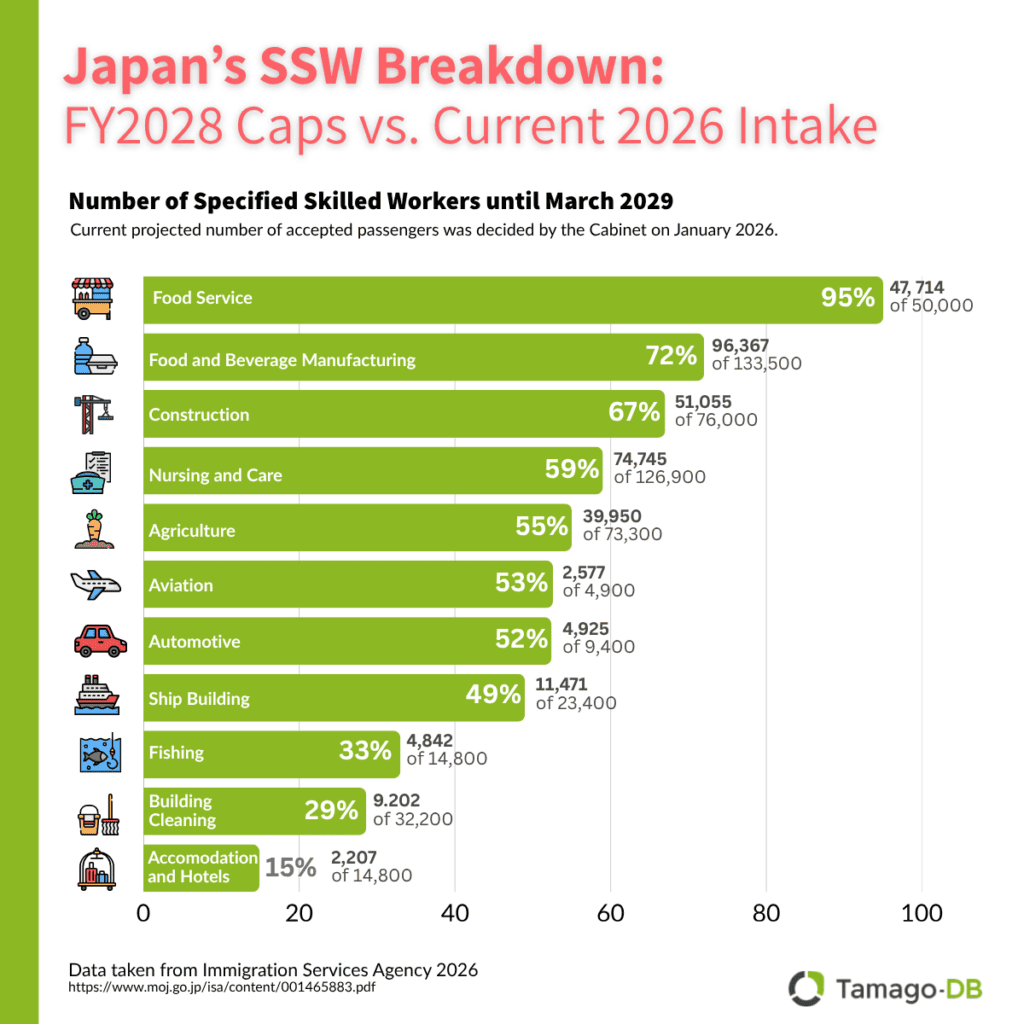
By March 2026, Japan’s food service sector had already reached 47,714 workers, hitting 95.4% of its FY2028 ceiling of 50,000. In response, the Immigration Services Agency of Japan (ISA) made history on April 13, 2026, by temporarily suspending new Certificate of Eligibility (COE) applications and skills evaluation tests for foreign restaurant workers. This development highlights a defining trend in Japan’s current foreign workforce policy: the transition from open-ended recruitment to an aggressively managed, quota-driven immigration ecosystem.
This marks a pivotal shift for talent acquisition leaders, headhunters, and agency recruiters: qualifying for a job and passing language or technical exams no longer guarantees entry if an industry’s national quota is exhausted. While Japan is broadening its borders, those entryways are managed by hard, enforceable sector caps.
Key Terms & Historical Policy
To understand today’s foreign hiring landscape, recruiters must navigate several foundational frameworks and policy shifts:
- Specified Skilled Worker (特定技能 / SSW):Introduced in April 2019 to address severe labor shortages by admitting foreign workers across designated industries.
- SSW No. 1 (SSW-1): Operational-level status allowing up to 5 years of residence; generally does not permit accompanying family members.
- SSW No. 2 (SSW-2): Advanced-tier status for highly skilled foreign talent. Allows unlimited visa renewals, local career progression, and sponsorship for spouses and children.
- Employment for Skill Development (育成就労): The statutory framework launching in April 2027 to replace the controversial Technical Intern Training Program (TITP / 技能実習). Rather than framing foreign labor as “international aid,” this reform establishes a 3-year career development pipeline that directly transitions workers into the SSW-1 visa stream.
- Certificate of Eligibility (COE):A pre-screening clearance document issued by Japanese Immigration to prove an applicant meets entry criteria.Visas cannot be issued abroad without a valid COE.
- Intake Ceilings (受入上限数): Government-mandated 5-year maximum resident limits per sector. Under strict policy enforcement, approaching a cap triggers an immediate freeze on new COEs.
Sector Capacity Breakdown: Where the Caps Stand
Under the SSW No. 1 framework, Japan set a collective limit of 805,700 workers through FY2028 across 19 sectors. However, quota utilization varies widely across industries:
| Industry Sector | Expected Intake Cap (FY2028 Target) | Current Residents (as of March 2026) | Cap Utilization Rate |
| Food Service | 50,000 | 47,714 | 95.4% |
| Food & Beverage Manufacturing | 133,500 | 96,367 | 72.2% |
| Construction | 76,000 | 51,055 | 67.2% |
| Nursing / Care | 126,900 | 74,745 | 58.9% |
| Agriculture | 73,300 | 39,950 | 54.5% |
| Aviation | 4,900 | 2,577 | 52.6% |
| Automotive Maintenance | 9,400 | 4,925 | 52.4% |
| Shipbuilding & Marine Industry | 23,400 | 11,471 | 49.0% |
| Fishery | 14,800 | 4,842 | 32.7% |
| Industrial Product Manufacturing | 199,500 | 59,038 | 29.6% |
| Building Cleaning | 32,200 | 9,202 | 28.6% |
| Accommodation / Hotels | 14,800 | 2,207 | 14.9% |
| Automotive Transport | 22,100 | 333 | 1.5% |
| Railway | 2,900 | 59 | 2.0% |
| Forestry | 900 | 8 | 0.9% |
| Wood Industry | 4,500 | 34 | 0.8% |
| Linen Supply | 4,300 | — | — |
| Logistics / Warehouse Operations | 11,400 | — | — |
| Resource Recycling | 900 | — | — |
| Total | 805,700 | 404,527 | 50.2% |
From 2026 Immigration Services Agency
(Note: Blanks for Linen Supply, Logistics, and Resource Recycling reflecting their recent addition as eligible sectors.)
The 1.23 Million Expansion Target
Despite individual sector freezes, Japan is expanding its aggregate capacity. When combining SSW No. 1 targets with the upcoming Employment for Skill Development program, Japan’s maximum resident capacity reaches ~1.23 million workers through FY2028:
- Specified Skilled Worker (SSW) No. 1: 805,700
- Employment for Skill Development: 426,200
- Combined Resident Ceiling: 1,231,900
To accommodate broader market needs, the government expanded the SSW structure to 19 industrial fields, opening new visa pathways in logistics/warehousing, resource recycling, and linen supply (which began accepting applications in June 2026).
Strategic Implications for Recruitment Professionals
For recruiters, talent advisory agencies, and HR directors, these policy realities require an immediate shift in search strategy:
- Audit Sector Headroom Before Sourcing: Avoid starting overseas recruitment drives without verifying quota availability. Sourcing for industries above 70% capacity (like Food Manufacturing) carries elevated risk of mid-campaign freezes.
- Pivot Sourcing to High-Capacity Sectors: For clients needing operational staff, redirect talent toward under-utilized visa categories like Accommodation/Hotels (only 14.9% filled) or newly added fields like Logistics.
- Separate SSW from Standard Professional Visas:Remember that white-collar visa categories, such as Engineer/Specialist in Humanities/International Services or Highly Skilled Professional, are not subject to SSW sector quotas. White-collar recruitment remains uncapped, provided candidates meet standard educational and compensation thresholds.
- Prepare Clients for the April 2027 Shift: The launch of Employment for Skill Development will establish structured 3-year development pipelines. Building talent channels now will allow recruiters to secure steady candidate flow directly into SSW-1 status in future years.
At Tamago-DB, we try to bring the latest market intelligence and regulatory updates to keep recruitment leaders informed across Japan and the Asia-Pacific region. In a fast-moving market, having technology built specifically for regional agency recruiting is essential. Applicant Tracking Systems (ATS) enable search firms to categorize talent effectively by visa status, monitor sector-specific pipeline metrics in real time, and pivot candidate matching strategies instantly. Ensure your recruitment workflows remain agile before quota disruptions impact placements.